
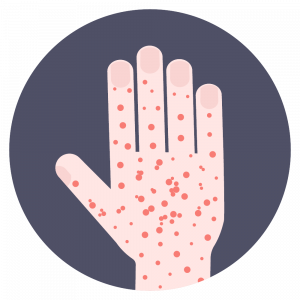
Measles is a very contagious disease caused by a virus that lives in the nose and throat of an infected person.
The virus is released when an infected person breathes or coughs. It spreads easily from person to person through the air or by direct contact with nose or throat discharges from someone who is infected. Measles symptoms include fever and a rash that starts on the face at the hairline and spreads to the neck, trunk, arms, legs, and feet. A cough, runny nose, or red, itchy eyes might also be present. Symptoms usually begin 7–14 days after exposure, but can appear up to 21 days after exposure. Measles is a serious illness that can cause complications that lead to hospitalization and even death.
Measles is easily preventable.
A safe and effective vaccine that prevents measles is given as part of the measles, mumps and rubella (MMR) vaccine or the measles, mumps, rubella and varicella (MMRV) vaccine series. Since measles-containing vaccines became available in the United States, the disease has become rare in this country. Over 90% of the U.S. population is vaccinated against measles and approximately 95% of kindergarteners in Virginia are vaccinated against measles. Two doses of the vaccine are given to provide lifetime protection. The first dose is routinely recommended at age 12-15 months and the second dose is recommended before kindergarten entry (age 4-6 years). Infants 6-11 months of age may receive a dose of MMR vaccine prior to traveling internationally or to regions experiencing a measles outbreak. This dose does not count towards the MMR vaccine series, and they should still receive two doses separated by at least 28 days after they reach 12 months of age.
Am I protected against measles?
You are considered immune and protected against measles if you have written documentation (records) showing at least one of the following:
- You received two doses of measles-containing vaccine, and you are a(n)
- School-aged child (grades K-12)
- Adult who will be in a setting that poses a high risk for measles transmission, including students at post-high school education institutions, healthcare personnel, and international travelers.
- You received one dose of measles-containing vaccine, and you are a(n)
- Preschool-aged child
- Adult who will not be in a setting that poses a high risk for measles transmission, including students at post-high school education institutions, healthcare personnel, and international travelers.
- A laboratory confirmed that you had measles at some point in your life.
- A laboratory confirmed that you are immune to measles.
- You were born before 1957.
If you’re unsure whether you’re immune to measles, you should first try to find your vaccination records or documentation of measles immunity. To check your immunization status, call your healthcare provider or request records from the VDH Immunization Record Request Form.
Measles in Virginia: 2025
VDH has reported three cases of measles in Virginia in 2025. VDH also continues to report public exposure locations in Virginia related to confirmed cases of measles in travelers.
On June 25, VDH was notified of a confirmed case of measles in an international traveler visiting North Carolina. The person traveled through Washington Dulles International Airport (IAD) on Thursday, June 19. Listed below are the dates, times, and locations of the potential exposure sites:
- Dulles International Airport on Thursday, June 19:
-
- Concourse A, on transportation to the International Arrivals Building (IAB), and in the baggage claim area between 7:45 p.m. and 11:59 p.m.
-
- Departures area of Main Terminal, East Security Checkpoint, on transportation to Concourse C and inside Concourse C between 8 p.m. and 11:59 p.m.
On June 14, VDH was notified of a confirmed case of measles in an international traveler visiting the Washington, D.C. area. The person traveled through Washington Dulles International Airport and on the Washington Area Metro on Sunday, June 8. Listed below are the dates, times, and locations of the potential exposure sites:
- Dulles International Airport (IAD) on Sunday, June 8:
-
- Concourse A, on transportation to the International Arrivals Building (IAB), and in the baggage claim area between 10:30 a.m. and 1 p.m.
- Washington Area Metro on Sunday, June 8:
-
- Silver Line Train from Dulles International Airport station transferring at the Metro Center Station to the Red Line Train heading towards Shady Grove Station between 11:30 a.m. and 2:30 p.m.
If you think you may have been exposed at any of the above locations, watch for symptoms for 21 days after the date of your potential exposure. People who are not immune should contact their local health department immediately to receive public health guidance for symptom monitoring and discuss post-exposure treatment options.
If you are experiencing symptoms of measles, contact your healthcare provider right away. Call ahead before going to your healthcare provider’s office or the emergency room to notify them that you might have been exposed to measles and ask them to call the local health department. This will help protect other patients and staff.
Virginia residents with additional questions about their exposure can email the Virginia Department Health at epi_response@vdh.virginia.gov or contact their local health department.
More information about measles is available:
- General information
- Information for healthcare personnel